Monday, March 12, 2012

The Heart of It All in Hoops

I got to watch the ESPN 30 for 30 documentary 'Guru of Go', the story of Paul Westhead and his run-and-gun system, which has been partially successful in a majority of his coaching stops. In the middle of the film, the emphasis was placed on the Loyola Marymount Tigers and star forward Hank Gathers, whose untimely death in the middle of a 1990 WCC tournament game sent shockwaves in the hoops world and galvanized the LMU community.

Hank Gathers and Reggie Lewis both died of heart-
related problems while still active players.
On March 4, 1990, during LMU's home game against the University of Portland Pilots, Gathers scored on an alley-oop pass off Terrell Lowery midway through the first half. A few seconds later, Gathers collapsed, and despite pleading not to lie down, he eventually followed the trainer's advice. Unfortunately, Gathers died on the way to the hospital of a heart attack at the age of 23. The entire WCC tournament was later cancelled and LMU earned an NCAA Tournament berth, eventually reaching the Elite 8.


Jeff Green and Chris Wilcox were both sidelined
indefinitely for heart issues.
Three years later, during an NBA playoff game between the Boston Celtics and the Charlotte Hornets at the Boston Garden, star forward Reggie Lewis collapsed while running on the court. It was later determined that he had a hypertrophic cardiomyopathy, which later caused his death on July 27, 1993 while on a practice session. Nearly two decades later, the Celtics learned from the Lewis debacle when forward Jeff Green was not cleared to play for the 2011-12 season because of an aortic aneurysm, and underwent surgery as a result. And just yesterday, forward Chris Wilcox was sent indefinitely to the inactive list for a potential heart defect. 

Both Eddy Curry and Cuttino Mobley experienced
heart-related ailments during their playing careers.
Also learning from the Lewis and Gathers experience, guard Cuttino Mobley, then of the New York Knicks, announced his retirement in 2008 after a physical revealed a hypertrophic cardiomyopathy, thus not clearing him for physical contact. Three years earlier, then-Chicago Bulls forward Eddy Curry was also diagnosed of a similar heart ailment that caused him to miss the Bulls' 2005 playoff run. After refusing a DNA test as suggested by some doctors, then-Bulls GM John Paxson sent Curry to the New York Knicks, which unfortunately didn't work out on Curry's part. After a near three-year sabbatical from hoops, Curry returned to action with the Miami Heat in 2012, having shed over 100 lbs during that span. 

Indeed, basketball involves some running, banging and hustling. Then again, physical fitness is a must for every player aspiring to be the best, especially when the heart is involved in all the action. 

Saturday, March 10, 2012

Seeing Green

A week from today will be St. Patrick's Day, and in every place full of Irish people, whether full or half-blooded, green is everywhere. From leprechauns to dyed bodies of water, March 17 is where people enjoy seeing green. And professional sports is no exception.

The NBA introduced the St. Patrick's Day uniform program during the 2005-06 season, and ran throughout the second to third week of March. The initial participants were the Boston Celtics, the Chicago Bulls and the New York Knicks, cities with high Irish populations. The Toronto Raptors became the fourth participant in 2008, but three years later, they decided to replace their green uniforms with a camouflaged green version in honor of Veterans Day. 

The Knicks' green uniforms were also used during Christmas Day games. They received much publicity during the 2009 NBA All-Star Weekend, where 5'9'' Nate Robinson, playing the role of Kryptonite (or 'Krypto-Nate'), wore the Knicks green jerseys and neon green sneakers to beat Dwight Howard (dressed in his Superman cape) in the Slam Dunk Contest. 

The NHL's New Jersey Devils have been honoring the holiday by rocking their retro 1980s uniforms during St. Patrick's Week. The uniform prominently features green on the logo and the pants, in contrast to the current black and red scheme they use today. Their retro uniforms were used regularly from 1982-92, before trading green for black. Currently the Minnesota Wild are the only team with a green sweater; they use them as alternates, while the Vancouver Canucks use green as trim color to their uniforms. 

Major League Baseball also had some instances of teams sporting green caps and jerseys during St. Patrick's week, even if it's still Spring Training. The Chicago White Sox took it a step further by wearing green caps and white pinstriped jerseys with green trim on September 17, as part of their 'Halfway to St. Patty's' promotion. The most prominent example came from the Boston Red Sox, who wore green caps and uniforms in April 2007 to pay tribute to the late Celtics president Red Auerbach, and in June 2008, when the Celtics won the NBA championship. 

Unfortunately, the NFL has no such practice, considering that they are in an offseason during spring and summer. But at least the Green Bay Packers, the Philadelphia Eagles and the New York Jets wear green. 

Now, is anyone ready to rock green next week?  I'm sure you are.

Friday, March 9, 2012

Pierce's 1000th


Nearly every Top 10 statistical category in Boston Celtics history includes their current captain and 14-year greenie Paul Pierce. This season, Pierce has surpassed not only Larry Bird, but also 22,000 career points, and is closing in on 1,000 career games, a milestone that only Robert Parish and John Havlicek had accomplished solely in the green and white. Today's game against the Portland Trail Blazers will be something to remember for Boston's No. 34, as he steps into the hardwood for the 1,000th time, only the third Celtic to do so.


John Havlicek led the franchise in points and games played, and he played two more years than Pierce and Robert Parish, his closest pursuers. Nearly every Celtic Top 10 category has Hondo's name on it, and that deserved a ticket into the Hall of Fame. And he's a pioneer too, revolutionizing the 'Sixth Man' concept of coming off the bench to provide instant offense. Add to that the now-famous steal he made back in the 1965 playoffs.


Robert Parish played more seasons and games than Havlicek overall, but he had an additional seven seasons in which he didn't don the classic green and white jersey, doing so for four seasons in Golden State, two in Charlotte, and one in Chicago. Of course, it was in Boston where he had tremendous success, with 14 seasons, three titles and nine All-Star appearances, while teaming up with frontcourt mates Kevin McHale and Larry Bird for 12 seasons. Indeed, 1,611 total games played remains a yardstick for longevity in the NBA, and only Parish can attest to that.

Today will mark a significant milestone in Paul Pierce's career, and TD Garden will pay witness to another 'truthful' moment in Celtics history. 

Saturday, March 3, 2012

Wilt 100 at 50; Dismissal Reports


Today marks the 50th anniversary of Wilt Chamberlain's 100-point game, held at Hershey, Pennsylvania in 1962 between the Philadelphia Warriors and the New York Knicks. Chamberlain scored 100 of the 169 points the Warriors had in a 22-point victory over the Knicks, and to this day, it remains the highest-scoring game by a player in NBA history. Happy anniversary to Wilt Chamberlain's 100-point game.

'Til We Meet Again: Flip Saunders
In my previous post, the Washington Wizards needed a coaching change after an 0-8 start and even considered forfeiting all 66 games in protest instead of hiring a new coach. Well, they did win two of the next nine, but the continued spate of losses eventually cost Flip Saunders his job and assistant Randy Wittman took over from there. Wittman did help avoid the Wizards from sinking even further, something Paul Silas and the Charlotte Bobcats were unable to prevent after a 16-game losing streak. Michael Jordan, time to act now and fire Silas.

'Til We Meet Again: Ron Wilson
In Toronto, the ship is also sinking for the Maple Leafs. After a promising start to the season that rewarded a contract extension for coach Ron Wilson, the Leafs went on a freefall, going 1-9-1 for much of February, ultimately costing Wilson his job, a choice general manager Brian Burke said was 'difficult', considering his mutual friendship with Wilson. He then hired another friend of his in former Anaheim Ducks coach Randy Carlyle, who was fired two months ago after the Ducks endured slow start. Burke and Carlyle worked together in the Ducks' 2007 Stanley Cup title run.

Randy Carlyle: We Met Again
After John Stevens briefly worked the sidelines for the Los Angeles Kings, Darryl Sutter was hired by the Kings on a permanent basis on December 17, 2011. Randy Cunneyworth's job in Montreal is on an interim basis, so expect the Habs to hire a permanent coach in the offseason soon. 

It's the final five weeks of the NHL season, so every game is expected to be competitive and tough as the race for the playoffs begin. Good luck.


Thanks Tek and Wake


The past few weeks saw the Boston Red Sox bid goodbye to two of their longest tenured players: catcher Jason Varitek, and pitcher Tim Wakefield. On February 17, Wakefield announced his retirement after a 20-year playing career, 17 of which were spent in Boston. Varitek then announced his retirement on March 1, having played 15 seasons in a Red Sox uniform. 

Both were key parts of the 2004 and 2007 World Series champions, and have been popular figures in Boston sports lore. Wakefield, who was the oldest active MLB player at the time of his retirement, held a majority of the Red Sox pitching records, including most innings played, most starts, oldest pitching winner, oldest complete game winner, and oldest player to appear in a Red Sox uniform. He finished behind Roger Clemens for most strikeouts, behind Bob Stanley for most games pitched, and behind Cy Young and Clemens for most wins. His only All-Star appearance came in 2009, at the ripe age of 42, becoming the second oldest first-time All-Star after Satchel Paige. He won the AL Comeback Player award in 1995 and the Roberto Clemente Award in 2010.

Varitek, on the other hand, had the most no-hitters caught in MLB history with four, catching with Hideo Nomo, Derek Lowe, Clay Buchholz and Jon Lester. He was a three-time All-Star, one-time Silver Slugger and one-time Gold Glove Award for catcher, as well as a one-time Heart and Hustle Award. Varitek also caught the most games in a Red Sox uniform, and also had the most postseason homers for a catcher, the most postseason games in a Red Sox uniform, and the most opening day starts at catcher in Red Sox history. He played his entire Major League career with the Red Sox from 1997-2011, and was the team's captain from 2005-11.

Thanks for the memories, Tek and Wake. The Red Sox Nation will miss you.


Friday, March 2, 2012

Choose Your Jersey: The Netminders (Part 2)

A great goaltender in ice hockey is a tremendous plus for stronger teams. Aside from a bevy of talented forwards and defensemen, the goaltender is perhaps the most important piece for any team. Good goaltending often leads to victory. Bad goaltending, especially when the offense scores in a hurry, occasionally leads to not only replacing the affected goaltender in favor of his backup, but also leads to a humiliating defeat as well. The number on the goaltender's back has been a tradition, carrying over from one generation to another. 

#33
Patrick Roy as a Canadien (left) and as an
Avalanche (right)
No goalie in NHL history will ever rival the success of one Patrick Roy. Four Stanley Cups (1986, 1993, 1996, 2001), three Vezinas (1989, 1990, 1992), five Jennings trophies (1987, 1988, 1989, 1992, 2002), three Conn Smythes (1986, 1993, 2001), an 11-time All-Star, four-time First Team and two-time Second Team, first goalie to play 1000 games, and most playoff games, shutouts and wins. Unmatched legacy for the greatest goalie of all-time. However, only a few goalies have ever suited up wearing No. 33, due to the fact that it has become associated with team captaincy in the NHL (see Henrik Sedin and Zdeno Chara).


#34
Miikka Kiprusoff (left) and James Reimer (right)
Miikka Kiprusoff of the Calgary Flames and James Reimer of the Toronto Maple Leafs currently hold the bragging rights to No. 34. Kiprusoff had become a legend in Calgary since arriving in 2003, earning an NHL record for lowest GAA with 1.69 that season, then followed up with a Vezina and Jennings trophies in the 2005-06 season. He is the Flames' all-time shutout leader, passing Dan Bouchard in 2007. Reimer is in his second season with the Leafs, and is considered their key piece to the team's future.


John Vanbiesbrouck
Perhaps the most famous goalie to wear No. 34 was John Vanbiesbrouck. 'Beezer' started with the New York Rangers, and was their starting goalie before the emergence of Mike Richter late in his tenure made him expendable. In 1993, he was drafted by the expansion Florida Panthers, and in only the franchise's third season, they reached the Stanley Cup Finals. However, despite his stellar goaltending, he couldn't overcome Patrick Roy and the Avalanche in a four-game sweep. After six more years with the Panthers, Flyers, Islanders and Devils, he retired from the game at 38. 


#35


From left: Tony Esposito, Mike Richter, and Tom Barrasso
Tony Esposito, Mike Richter and Tom Barrasso wore No. 35 for a majority of their careers. Esposito, the younger brother of Boston's Phil, started his career a champion with the 1969 Canadiens before embarking on a long career with the Blackhawks. He and Phil were both enshrined in the Hockey Hall of Fame. Richter played his entire career with the New York Rangers, winning the Stanley Cup in 1994, and was later enshrined in the US Hockey Hall of Fame. Barrasso spent a majority of his career with the Pittsburgh Penguins, winning the Stanley Cup twice from 1991-92, and was also enshrined in the US Hockey Hall of Fame. 


Jean-Sebastien Giguere (left) and Pekka Rinne (right)
The number has been worn by a majority of goalies today, including Pekka Rinne of the Nashville Predators and Jean-Sebastien Giguere of the Colorado Avalanche. Other notables include the Detroit Red Wings' Jimmy Howard and Vancouver Canucks backup goalie Cory Schneider. As of this writing, Giguere, Howard and Schneider are among the top 10 goalies in GAA this season, which underscores the importance of wearing No. 35.


#39
Dominik Hasek
He is Europe's answer to Patrick Roy, and there is no doubt that Dominik Hasek is the greatest goalie from the other side of the Atlantic. Hasek began wearing his iconic No. 39 when he first suited up for the Buffalo Sabres, and has kept that number on two other stops with the Detroit Red Wings and Ottawa Senators. 'The Dominator' is a six-time All-Star, six-time All-NHL, a six-time Vezina winner, two-time Hart winner, three-time Jennings winner, and two-time Stanley Cup champion. Hasek's all-around flexibility, focus and footwork has made him one of the greatest goalies of all-time, and undoubtedly will be enshrined in the Hockey Hall of Fame once his playing days are done.


Rick DiPietro
The same couldn't be said of the New York Islanders' Rick DiPietro, whose misadventures and bad luck has been well-documented. The first overall pick of the 2000 NHL draft wore No. 1 from his rookie year to the 2003 season, after which he started wearing the No. 39. DiPietro did reach his peak from the 2003-04 until the 2007-08 season, when he played at least 55 games and was named an All-Star in 2008. After that injuries would take its toll on this once-prodigious talent, and as of 2012, he is sidelined indefinitely with a groin injury. 


Two other goalies are wearing No. 39 this season: Anders Lindback of the Nashville Predators and Brad Thiessen of the Pittsburgh Penguins, both backups. 


For now, the search for the next Dominik Hasek continues on. And how much more does Rick DiPietro have left?


#40
Clockwise from left: Patrick Lalime, Frank Pietrangelo, and
Tuukka Rask
The number of choice by current Detroit Red Wings defenseman Henrik Zetterberg, it has also be donned by backup goalies such as Patrick Lalime, Frank Pietrangelo, and Tuukka Rask. Lalime was the starting goalie during his time with the Ottawa Senators, and also backed up Tom Barrasso in Pittsburgh, and Ryan Miller in Buffalo. Pietrangelo also backed up Barrasso during the Penguins' 1991 Stanley Cup title season, and also played for the Hartford Whalers after being traded in the middle of another Penguins' championship season in 1992. Rask has become an able backup for incumbent starting goalie Tim Thomas and became the second Finnish netminder after Antti Niemi to win the Stanley Cup, after the Boston Bruins won it all in 2011. 


Two other backups, Devan Dubnyk of the Edmonton Oilers, and Robin Lehner of the Ottawa Senators, also wear No. 40.


#41
Mike Smith (left) and Jaroslav Halak (right)
The No. 41 is currently worn by starting goalie Mike Smith of the Phoenix Coyotes, and backup goalie Jaroslav Halak of the St. Louis Blues. Halak has been a superb backup for Brian Elliott, and their success as a pair has lifted the Blues to playoff contention under the coaching of Ken Hitchcock. Smith was given a chance in Phoenix after backing up Dwayne Roloson in Tampa Bay, and has led the Coyotes to playoff contention as well. Same credit goes to Brian Anderson of the Ottawa Senators who has led them to contention this year. 


Other notable numbers include New York Islanders' Evgeni Nabokov's No. 20, New York Rangers' Martin Biron's No. 43, and Florida Panthers' Jose Theodore's No. 60. 


Now, which number you want to wear if you're an aspiring goalie? 

Thursday, March 1, 2012

Choose Your Jersey: The Netminders (Part 1)

A great goaltender in ice hockey is a tremendous plus for stronger teams. Aside from a bevy of talented forwards and defensemen, the goaltender is perhaps the most important piece for any team. Good goaltending often leads to victory. Bad goaltending, especially when the offense scores in a hurry, occasionally leads to not only replacing the affected goaltender in favor of his backup, but also leads to a humiliating defeat as well. The number on the goaltender's back has been a tradition, carrying over from one generation to another. 

#1
From left: Jonas Hiller, Roberto Luongo, and Brian Elliott
Most goaltenders have worn No. 1 throughout history because during the 'Original Six' era teams dress only one goaltender and is given the choice of either 1 or 30, which represents the two ends of the standard jersey number range. Today, players such as Jonas Hiller of the Anaheim Ducks and Roberto Luongo of the Vancouver Canucks are carrying the tradition of the No. 1. The current top goalie in terms of GAA, Brian Elliott of the St. Louis Blues, also wears No. 1. 

Jacques Plante (left) and Bernie Parent (right)
The No. 1 was retired by five teams. The Montreal Canadiens retired the number for legendary Jacques Plante, while the Philadelphia Flyers retired it for Bernie Parent. Both Parent and Plante were feared by opponents for their fiberglass mask, which was popularized by Jason Voorhees in the Friday the 13th films. They were also Stanley Cup winners on their own right. In addition, the Detroit Red Wings retired it for Terry Sawchuk, the New York Rangers for Eddie Giacomin, and the Chicago Blackhawks for Glenn Hall. Glenn 'Chico' Resch, now a popular broadcaster for the New Jersey Devils, also wore No. 1 for a good part of his playing career with the Devils. Of special note, Georges Vezina, whose award was named after him, also wore No. 1 during his playing career.

#29
Ken Dryden (left) and Marc-Andre Fleury (right)
Ken Dryden made the number famous, and Marc Andre-Fleury has carried over the tradition. Dryden was on goal during the Montreal Canadiens' four consecutive Stanley Cup titles from 1976-79, in addition to two more in 1971 and 1973, while Fleury was an integral part of the Penguins' 2009 Stanley Cup title run. Dryden was also a  five-time first team All-Star and a four-time NHL leader in wins. Fleury has been one of the winningest goalies in Pittsburgh Penguins history, trailing only Tom Barrasso in wins. Tomas Vokoun is another notable netminder in No. 29.

#30
Clockwise from left: Martin Brodeur, Tim
Thomas, Ryan Miller and Henrik Lundqvist
No. 30 is also consider a traditional goaltender number, rivaling only the No. 1 (see above on the tradition). In recent years, however, the No. 30 became more famous because of the goaltending exploits of Martin Brodeur. Brodeur, whose NHL career is approaching the 20-year mark, is the all-time leader in goalie wins and shutouts, accomplishing it while with the New Jersey Devils, with three Stanley Cup rings (1995, 2000, 2003) to boot. The Boston Bruins' Tim Thomas is another notable in No. 30. In the 2010-11 season, Thomas set a single-season GAA record with .938, while becoming the oldest Conn Smythe winner for the 2011 Stanley Cup champions. Henrik Lundqvist of the New York Rangers is another record setter, with 30+ win seasons in his first seven years as an NHL netminder. Ryan Miller of the Buffalo Sabres is also another notable, who recently passed the legendary Dominik Hasek in the all-time wins list in Sabres history.

Mike Vernon (left) and Rogetien Vachon (right)
Only two teams have retired the No. 30, and both were goalies. The Calgary Flames retired the number for Mike Vernon, while the Los Angeles Kings retired it for Rogatien Vachon. Vernon played for the Flames from 1982-94 and from 2000-02, winning the Stanley Cup in 1989. He also won the Stanley Cup with the Detroit Red Wings in 1997. Vachon was the backbone of the expansion Kings teams during the 1970s, setting numerous Kings franchise goaltending records during his time. Prior to Los Angeles, Vachon won three Stanley Cups (1968, 1969, 1971) with the Montreal Canadiens. 

Now one must wonder, why did the Bruins pass up on retiring No. 30 for Gerry Cheevers and gave it to Tim Thomas? Oh well, it's up to you to debate who's the better goalie in black and gold.

#31
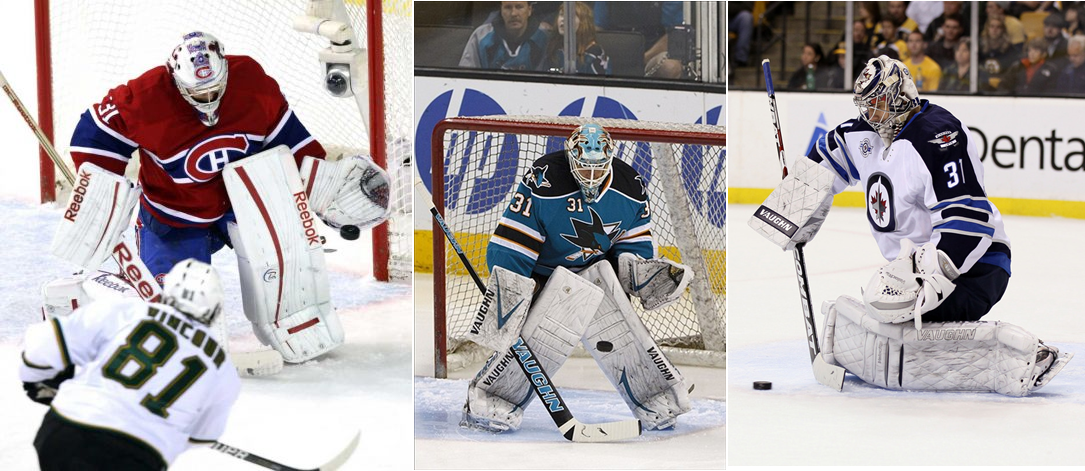
From left: Carey Price, Antti Niemi, Ondrej Pavelec
It was the number that made winners out of Grant Fuhr of the Edmonton Oilers and Billy Smith of the New York Islanders. Smith won four straight Stanley Cups from 1980-83, while Fuhr followed that up with five Stanley Cups in seven years from 1983-90. Today the number is worn notably by the Montreal Canadiens' Carey Price, the San Jose Sharks' Antti Niemi, and the new Winnipeg Jets' Ondrej Pavelec, who are looking to continue the number's tradition. 

Grant Fuhr (left) and Billy Smith (right)
No. 31 was also worn by Pelle Lindbergh of the Philadelphia Flyers, whose unfortunate and tragic passing in 1985 shocked the Flyers and the NHL in particular. Dominik Hasek, more famous for No. 39, wore No. 31 during his early years with the Chicago Blackhawks. Olaf Kolzig, even though he wore No. 37 for a majority of his time with the Washington Capitals, wore No. 31 early in his D.C. career. 

#32
Niklas Backstrom (left) and Jonathan Quick (right)
No. 32 was retired by the Washington Capitals for forward Dale Hunter, but the number has been used recently for goalies as well. Ask Niklas Backstrom of the Minnesota Wild and Jonathan Quick of the Los Angeles Kings, whose early-season spark this year has led the Kings and Wild into playoff contention. Other notable goalies to wear this number include the Tampa Bay Lightning's Mathieu Garon and Kari Lehtonen of the Dallas Stars.

More classic netminder numbers in the next blog.